Dedicated Development Team: The 2026 Decision-Maker's Guide
Table of Contents
- How a Dedicated Team Actually Works
- Dedicated Team vs. Other IT Outsourcing Models
- How to Hire a Dedicated Development Team (Without Getting Burned)
- Managing a Dedicated Development Team Effectively
- Red Flags to Watch for When Evaluating Vendors
- What Makes a Dedicated Team Model Succeed Long-Term
- Conclusion
- FAQ
You need to ship faster. Your internal team is stretched thin, hiring locally takes months, and the clock is ticking on your roadmap. Sound familiar?
You’re not alone. According to Deloitte’s Global Outsourcing Survey, 76% of companies already outsource IT functions. The question isn’t whether to outsource — it’s which model actually fits your situation.
A dedicated development team is one answer to that question, but only the right one when deployed correctly. Choose the wrong engagement model and you’ll burn budget and time on misaligned expectations.
Over 70 projects across energy, fintech, healthtech, and SaaS, we’ve seen what breaks when a team is assembled too fast — and what holds when it’s built with intention. One of those relationships has been running for over five years, through a 10× growth in users and six major infrastructure upgrades, on infrastructure we still maintain today.
This guide distills those lessons into a practical framework for CTOs, product leads, and engineering heads evaluating their next move.
How a Dedicated Team Actually Works
A dedicated development team is an outsourced team of software engineers, designers, QA specialists, and other technical roles who work exclusively on your project, typically under your direct management. Unlike staff augmentation (individual contractors) or fixed-price projects (predefined scope), a dedicated team functions as an embedded extension of your organization — aligned to your processes, tools, and long-term goals — while being employed and managed through a vendor.
What Is a Dedicated Development Team?
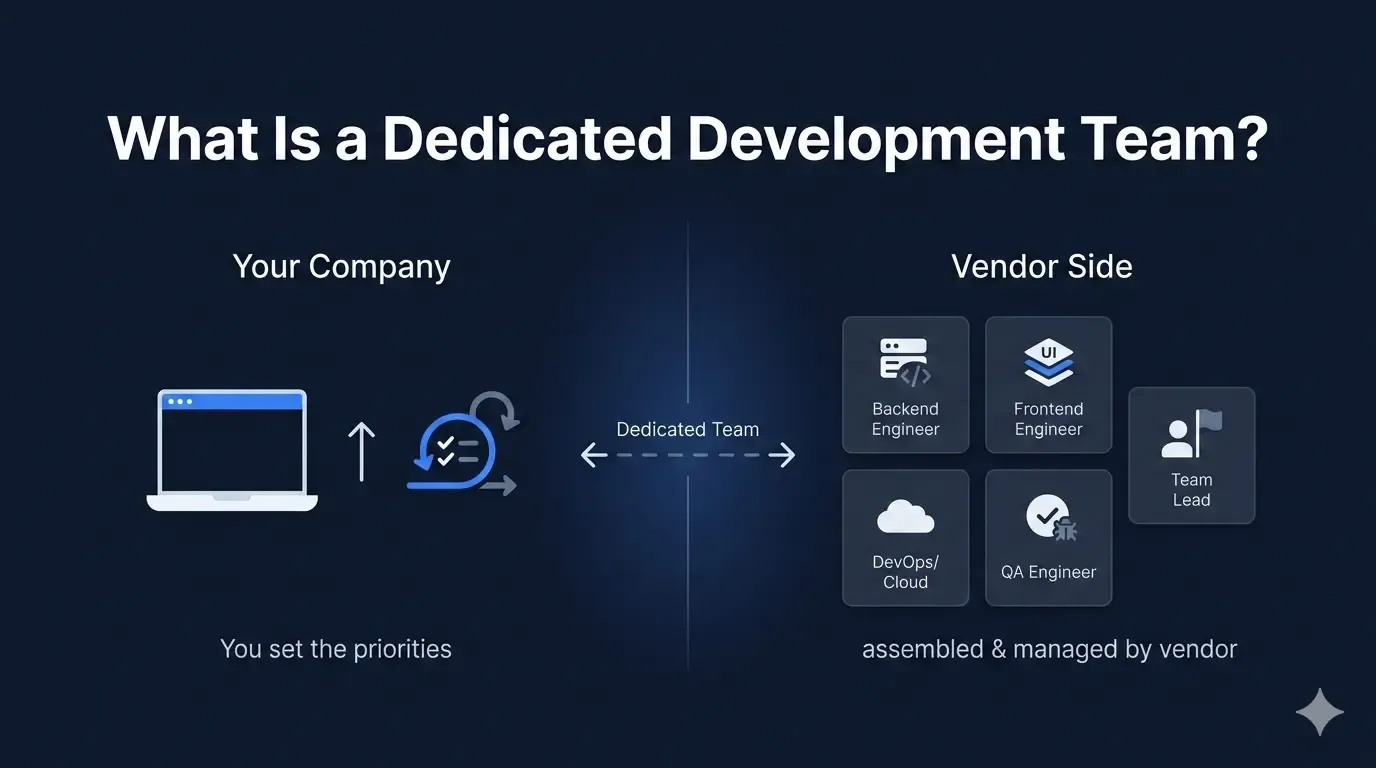
A dedicated development team is a pre-vetted group of technical specialists — typically including backend developers, frontend engineers, QA engineers, DevOps, and a team lead or project manager — assembled by an outsourcing partner and assigned to work exclusively on your product.
The key distinction: they’re yours in practice, even if they’re employed by the vendor. You run the standups, define the sprint goals, and set the priorities. The vendor handles HR, payroll, benefits, office space, and talent replacement.
This model sits between staff augmentation (you hire individuals to fill gaps) and fully managed outsourcing (the vendor owns the delivery). It gives you team-level scale without the overhead of direct employment.
What Does a Dedicated Team Typically Include?
Team composition depends on your product stage, but a typical engagement might include:
- 1–2 senior backend engineers (Node.js, Python, Go, or Java)
- 1–2 frontend engineers (React, Vue, or Angular)
- 1 DevOps/cloud engineer (AWS, GCP, or Azure)
- 1 QA engineer (manual and/or automation)
- 1 team lead or engineering manager (optional, but valuable for larger teams)
You scale up or down as the project evolves — without the sunk cost of full-time hiring.
 Dedicated development team structure showing client-side and vendor-side roles
Dedicated Team vs. Other IT Outsourcing Models
One of the most common mistakes decision-makers make is choosing an engagement model based on price rather than fit. Here’s how the main models compare:
| Model | Best For | Control Level | Pricing | Risk |
|---|---|---|---|---|
| Dedicated Team | Long-term product development | High | Monthly retainer | Medium |
| Staff Augmentation | Short-term skill gaps | Very High | Hourly/daily | Low |
| Fixed-Price Project | Well-defined, bounded scope | Low | Fixed | High (scope creep) |
| Time & Material | Exploratory or evolving projects | Medium | Hourly | Medium |
The dedicated team model offers the best balance when you need sustained velocity over several months with a team that understands your codebase, your architecture, and your business goals.
Fixed-price works if you can define requirements down to a feature list before development starts. Most scaling companies can’t — and paying the penalty of rework is expensive.
When Staff Augmentation Makes More Sense
If you need one senior React developer for a three-month feature push, staff augmentation is cleaner and cheaper. You’re not building a team; you’re filling a seat.
That said, it’s often where longer engagements begin. A pattern we see regularly at Perfsys: a client hires a single DevOps engineer or Python developer for a specific problem, the work goes well, and three months later they’re adding a QA engineer and a second backend developer. What started as filling one seat quietly becomes a dedicated team. If you sense that’s the trajectory, it’s worth structuring the initial engagement with that expansion in mind.
Where the model breaks down is when you need multiple roles to collaborate from day one, or when the engagement will clearly extend beyond six months. At that point, a dedicated team structure gives you better continuity and far less coordination complexity.
Not sure which model fits your situation?
If you’re weighing a dedicated team against other engagement options, a 30-minute technical alignment session with Perfsys can help you map the right structure to your roadmap and budget — before you talk to any vendor.
When Should You Hire a Dedicated Development Team?
The dedicated model isn’t right for every situation. Here’s how to know when it fits.
You’re a good candidate if:
- Your product roadmap extends 6–18+ months and requires sustained engineering capacity
- You need a cross-functional team, not just one or two developers
- Internal hiring is too slow or too expensive for the pace you need
- You want team-level continuity — engineers who understand your technical debt, your architecture decisions, and your customers
- You’re scaling a cloud-native product and need specialists who can own infrastructure alongside application code
Reconsider if:
- You have a fixed, clearly scoped deliverable with no expected changes
- You need someone for fewer than three months
- You’re not ready to actively manage an external team — you’ll need at least one internal point of contact who can run sprints and review work
The Remote AWS Development Team Use Case
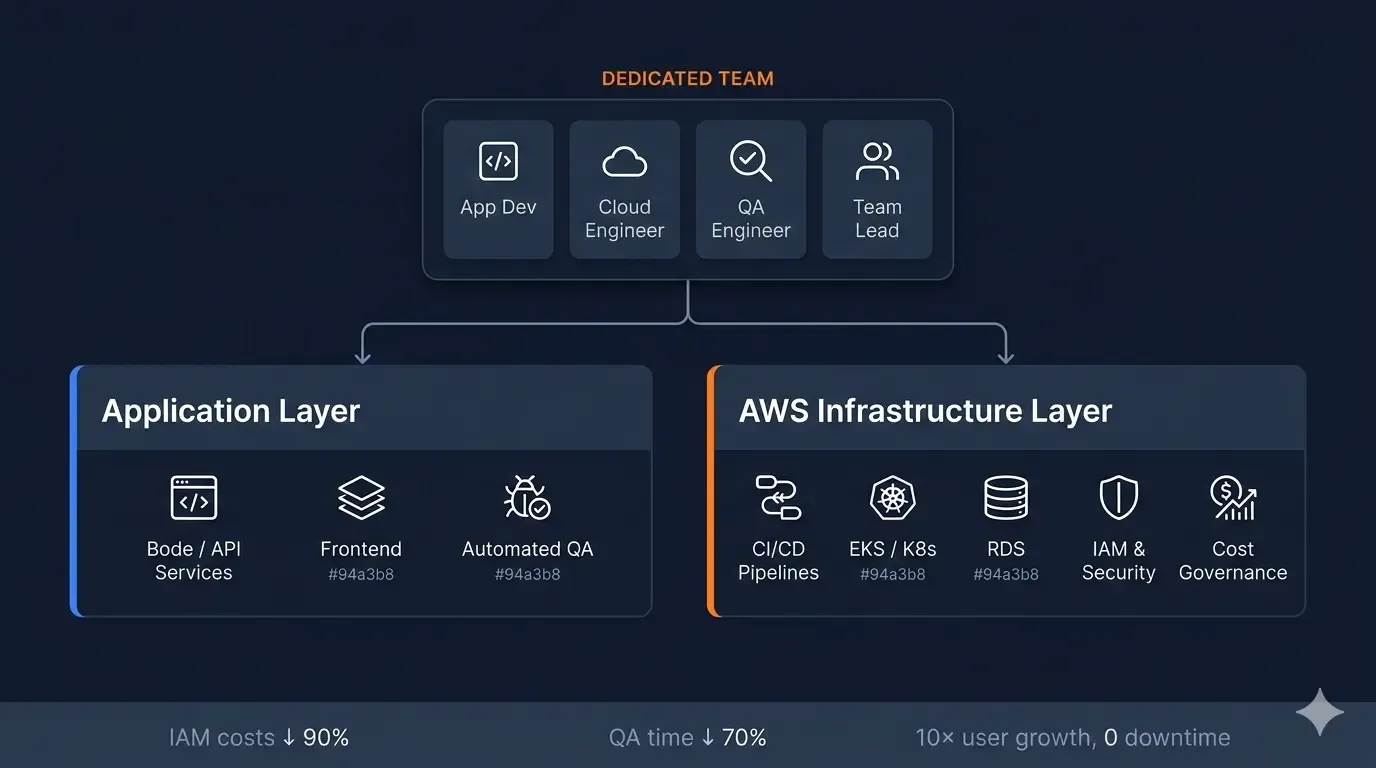
One increasingly common scenario: companies building on AWS need a remote AWS development team that goes beyond application developers. They need engineers who can own the cloud infrastructure — setting up CI/CD pipelines, managing Kubernetes clusters, configuring RDS, implementing cost governance, and handling security compliance.
A concrete example: Perfsys designed and built a Keycloak-based identity management system on AWS my-vpa, a DACH-region SaaS platform — using EKS, RDS, ALB, EC2, and CloudWatch — replacing commercial SaaS tools (Auth0, Okta) that were costing hundreds of dollars per month. IAM costs dropped by over 90%, down to approximately $60/month. The platform then supported a 10× increase in user growth over five years with zero performance degradation and no service downtime across six major infrastructure upgrades.
A similar pattern played out in fintech: a dedicated team reduced manual QA time by 70% and improved AI model accuracy from 80% to 95% within six weeks, using AWS Bedrock and automated evaluation pipelines.
These outcomes require engineers with cloud ownership mentality, not just execution capacity. They also illustrate why a dedicated team outperforms a fixed-price engagement for cloud-native products: architecture decisions, Kubernetes upgrades, and cost optimization don’t fit neatly into a bounded scope. You need an ongoing team with continuity and context.
 Remote AWS development team ownership across application and cloud infrastructure
Dedicated Development Team for Startups vs. Enterprise
The dedicated team model works across company sizes, but what “works” looks like is different depending on where you are. A seed-stage SaaS startup and a 500-person enterprise both benefit from dedicated teams — they just need different things from them.
For startups and scale-ups, the dedicated team is usually the engineering team, or most of it. You’re not adding to an existing engineering team — you’re building one from scratch. That changes what you actually need from the team.
Speed matters more than process. You need engineers who can context-switch, make decisions without escalation, and own outcomes end-to-end — not specialists who only work within a narrow role. The ideal dedicated team for an early-stage company is small (3–5 people), senior-heavy, and comfortable operating in ambiguity. A team of five mid-level developers managed by a remote project coordinator is the wrong fit at this stage. You want fewer, sharper people with real ownership.
Cost discipline matters too. Startups running on 12–18 month runways need predictable burn. The monthly retainer model of a dedicated team works well here — it’s a fixed line on the P&L, easier to plan around than hourly billing. The risk is over-hiring: assembling a team sized for your 12-month roadmap when your immediate needs could be covered by three engineers and a DevOps lead.
What we consistently see at Perfsys: early-stage companies that start with a lean, senior-heavy dedicated team ship faster and burn less than those who scale the team up front. You can always add. Unwinding a team that’s too large is expensive and disruptive.
For mid-market and enterprise companies, the dynamic inverts. You likely already have internal engineering capacity — the dedicated team’s job is to extend it without competing with it. That introduces a different set of challenges.
Integration matters more than speed. The dedicated team needs to plug into existing processes, codebases, and tooling without creating a parallel track that diverges from internal standards. A dedicated team operating with a separate sprint cadence, separate tooling, or separate code review standards is a coordination tax, not an asset. The onboarding investment is higher for enterprise engagements, but it pays for itself in reduced friction over a 12–24 month horizon.
Governance matters more too. Enterprise buyers typically need formal SLAs, security compliance documentation (SOC 2, ISO 27001, GDPR), and clear IP assignment language from day one. Vendors who can’t produce these aren’t enterprise-ready, regardless of their technical capability.
A pattern we see regularly at this company stage: the dedicated team is brought in to own a specific product area — a new platform, a data pipeline, a mobile product — while internal engineers focus on the core. The boundary is well-defined, the handoff points are clear, and the dedicated team operates with significant autonomy. That’s the model that produces the best outcomes at scale.
| Startup / Scale-up | Mid-market / Enterprise | |
|---|---|---|
| Team size | 3–6, senior-heavy | 5–12, mixed seniority |
| Integration depth | High — often the entire eng team | Medium — extends internal capacity |
| Process maturity needed | Low — team adapts to your chaos | High — team must fit your standards |
| Governance requirements | Basic NDA, IP assignment | SOC 2, GDPR, formal SLAs |
| Key risk | Hiring too many too early | Parallel track divergence |
| Time to productivity | 2–3 weeks | 4–6 weeks |
The common thread: in both cases, the dedicated team model outperforms fixed-price or staff augmentation when you need sustained delivery over 6+ months. The variables are team composition, governance expectations, and how deeply the team integrates into your existing organisation.
How to Hire a Dedicated Development Team (Without Getting Burned)
The outsourcing market is crowded. Here’s a practical framework for evaluating vendors.
Define Your Requirements Before You Talk to Anyone
Before your first vendor call, document:
- Tech stack requirements (languages, frameworks, cloud platforms)
- Team size and roles needed
- Engagement duration (initial contract + expected extension)
- Time zone overlap requirements — most North American and European companies need at least 4 hours of daily overlap
- Communication and reporting expectations
- Security and IP requirements (NDAs, data handling, code ownership)
Vendors will shape their pitch around whatever requirements you give them. If you don’t define these upfront, you’ll get generic proposals and spend weeks calibrating.
Evaluate Technical Depth, Not Just Portfolios
A vendor’s portfolio shows you what they’ve delivered. It doesn’t show you who actually built it, or whether those same engineers are available for your project.
During the evaluation process:
- Request team profiles, not just CVs — you want to understand how the proposed team has worked together before
- Conduct technical interviews with the actual engineers who will work on your project, not sales engineers
- Ask for a paid discovery sprint — a one- to two-week paid engagement to assess communication quality, code quality, and process fit before committing to a longer contract
- Check references from clients with similar technical requirements — a vendor excellent at ecommerce platforms may be a poor fit for a fintech product with strict compliance needs
Understand the Commercial Model
Dedicated team engagements are typically priced as monthly retainers per team member, based on seniority and role. Expect significant variation by geography:
- Eastern Europe (Ukraine, Poland, Romania): $35–75/hr per developer
- Latin America (Colombia, Mexico, Brazil): $30–65/hr
- Southeast Asia (Vietnam, Philippines): $20–45/hr
- North America/Western Europe: $100–200/hr
Monthly team costs for a five-person dedicated team typically range from $25,000–$70,000 depending on geography, seniority mix, and vendor margin. Most reputable vendors offer three- or six-month minimum contracts. Be cautious of vendors who push for annual commitments upfront without a pilot phase.
Managing a Dedicated Development Team Effectively
Hiring a dedicated team is the beginning, not the end. How you manage them determines whether you get 60% or 100% of the value.
Treat Them Like an Internal Team (Because They Are)
The most common failure mode: clients treat dedicated teams like vendors on retainer — passive, waiting to be told what to do, and evaluated primarily on hours billed.
The most successful engagements treat the dedicated team as an embedded part of the organization. That means including them in company all-hands or product reviews when relevant, giving them context on business goals rather than just technical tickets, establishing a single accountable owner on your side who runs sprints and reviews work, and providing structured feedback loops — not just bug reports.
Set Up the Right Operational Foundations
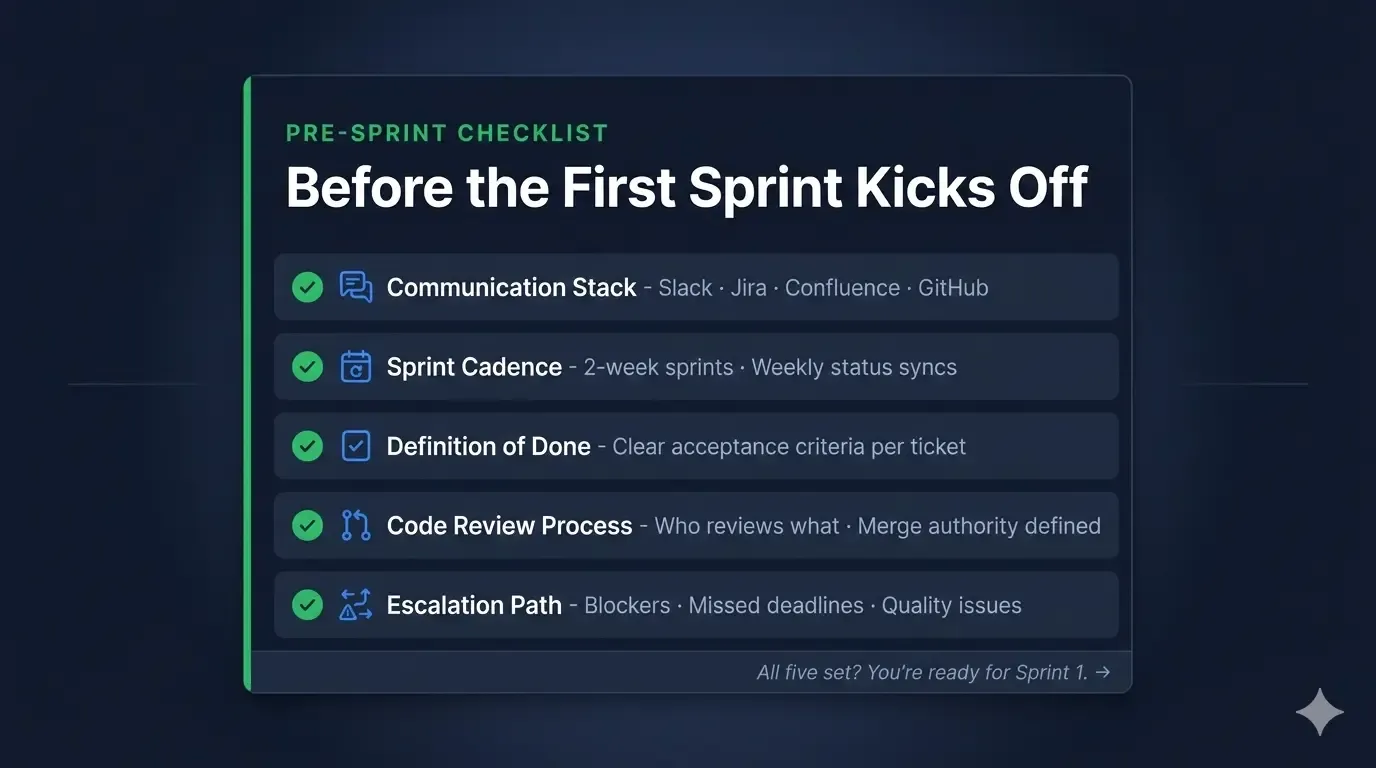
Before the first sprint kicks off, establish:
- Communication stack: Slack, Jira, Confluence, GitHub — whatever your internal team uses
- Sprint cadence: Two-week sprints with weekly status syncs work well for most teams
- Definition of done: Clear acceptance criteria prevent costly rework
- Code review process: Who reviews what, and who has merge authority
- Escalation path: What happens when there’s a blocker, a missed deadline, or a quality issue
 Pre-sprint checklist for onboarding a dedicated development team
Onboarding a Dedicated Development Team — Timeline and KPIs
Hiring a dedicated team and onboarding one are two different problems. The first ends when you sign. The second ends — if you do it well — around week 10 or 12, when the team is shipping at full velocity with minimal hand-holding from your side.
Most of the failures we see don’t happen during the engagement. They happen in the first six weeks, when expectations aren’t set, context isn’t transferred, and the team is left to reverse-engineer both the codebase and the business model at the same time.
Here’s what a structured onboarding actually looks like.
Weeks 1–2: Context transfer
The team’s first job isn’t to write code. It’s to understand what they’re building and why. That means access to your product roadmap, architecture documentation, and existing codebase — but more importantly, direct conversation with your product owner or CTO about what the product is trying to do and what decisions have already been made.
At this stage: set up the full communication stack (Slack channels, Jira or Trello board, GitHub access, Confluence, Notion, or Asana — whatever your internal team already uses), establish the sprint cadence and definition of done, and run a single architecture review session where the team can ask the questions that documentation doesn’t answer.
A good sign at the end of week 2: the team can explain your product architecture back to you without prompting.
Weeks 3–6: First sprint, reduced expectations
The first sprint should be scoped conservatively — existing feature work, small bugs, or clearly bounded new functionality. The goal isn’t output. The goal is establishing workflow: how the team asks questions, how they handle blockers, how code gets reviewed, and whether their delivery process integrates cleanly with yours.
Resist the temptation to load the first sprint with high-priority work. New engineers — however senior — need time to understand the codebase and product before you put high-stakes work in front of them. A team that ships smaller things cleanly in week 4 will outperform a team that rushes high-stakes work in week 3 every time.
Weeks 7–12: Ramp to full velocity
By week 7, the team should be operating independently on most work items — raising blockers clearly, making architectural micro-decisions without escalation, and reviewing each other’s code. Your involvement shifts from directing to reviewing.
By week 12, a well-onboarded dedicated team should be operating at 80–90% of a fully embedded internal team. If they’re not, the gap is almost always one of two things: insufficient context transfer at the start, or an unclear product owner on your side.
KPIs worth tracking from day one
Most clients track output (tickets closed, features shipped). That’s necessary but not sufficient. The metrics that actually predict whether a dedicated team is working are different.
- Sprint commitment accuracy — what percentage of committed sprint items are completed by the end of the sprint. Below 70% consistently signals either poor estimation, unclear requirements, or context gaps. Above 90% consistently may signal the team is sandbagging.
- Bug escape rate — how many bugs surface in production vs. caught in QA. A team that ships fast but leaks bugs into production is creating hidden cost. Track this separately from velocity.
- Time to first meaningful PR — how quickly does a new team member submit a pull request that gets merged? For senior engineers, this should be within 5 business days of access. Longer than that points to onboarding friction or access provisioning delays on your side.
- Blocker resolution time — how long does it take for a raised blocker to be resolved? If the average is more than 48 hours, you have a process problem, not a team problem.
- Turnover — track this from month one. A dedicated team where one engineer is replaced in the first six months has lost a meaningful amount of context. Two replacements in six months is a vendor problem.
These aren’t metrics to put in a dashboard and forget. They’re conversation starters — numbers that tell you where to look when something feels off before it becomes a real problem.
Red Flags to Watch for When Evaluating Vendors
Even experienced buyers get burned. These signals should slow you down:
- No technical interviews offered — if you can’t meet the engineers before signing, walk away
- Promises of immediate team availability — strong senior engineers are rarely sitting idle
- Vague SLAs — “we’ll replace underperforming developers” means nothing without a defined timeline and process
- Resistance to paid pilots — legitimate vendors welcome paid discovery engagements; they filter out misaligned clients too
- Lack of clear IP and code ownership clauses — all code produced should be yours from day one
What Makes a Dedicated Team Model Succeed Long-Term
The teams that deliver the most value over 12–24+ months share a few characteristics.
They have low turnover. Ask vendors what their average engineer tenure is. High churn — even if the vendor replaces developers quickly — is expensive in lost context and ramp-up time. The engineers who designed your original architecture are the ones who understand why certain decisions were made. Losing that institutional knowledge mid-project is a setback most teams underestimate until it happens.
They have proactive technical ownership. The best dedicated teams don’t just execute tickets; they flag architectural risks, suggest optimizations, and push back on decisions that would create technical debt. You want engineers who act like owners, not contractors.
They have aligned incentives. Some vendors charge for headcount regardless of output. Others structure retention incentives around client satisfaction and project milestones. The latter alignment tends to produce better outcomes.
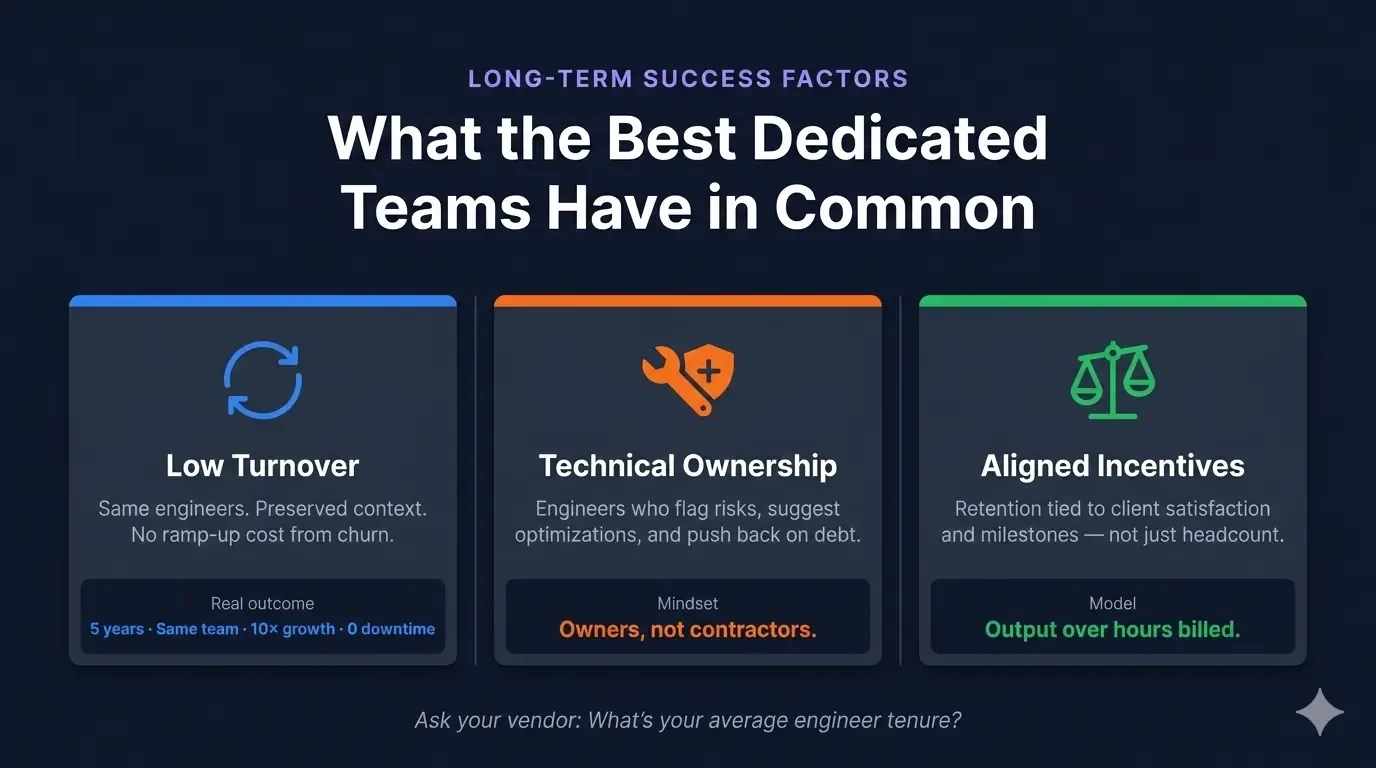 Long-term success factors: low turnover, technical ownership, and aligned incentives
Conclusion
”They are proactive and have creative ideas on how to approach the very unique set we have in our company.” — Ingmar Bornholz, ex-CEO, My-VPA 5.0/5 on Clutch across quality, schedule, cost, and willingness to refer)
That’s what a dedicated development team looks like at its best — not a project handoff, but a long-term technical partnership that scales with the business.
The dedicated model is one of the most effective ways to scale engineering capacity without the overhead, risk, and timeline of direct hiring — when you choose the right vendor, define the engagement clearly, and manage the team as a genuine extension of your organization.
The decision isn’t just about cost. It’s about finding the right IT outsourcing model for your stage, your stack, and your roadmap. Dedicated teams outperform on long-horizon product work. They underperform when scope is fixed, timelines are short, or the client lacks internal bandwidth to manage them.
Perfsys is an AWS Consulting Partner with 10 years of cloud engineering experience, serving 30+ international clients across Europe and North America. If you’re evaluating whether a dedicated team is the right next step, start with a technical alignment conversation — a structured session that surfaces your real requirements before any contract is signed.
Explore Perfsys case studies to see how dedicated teams have delivered for clients in fintech, healthtech, and SaaS — or visit our blog for more on cloud engineering and outsourcing strategy.
FAQ
What is a dedicated development team?
A dedicated development team is an outsourced group of software engineers, QA specialists, DevOps, and other technical roles who work exclusively on your product under your direct management. Unlike a fixed-price project, the team operates as a long-term extension of your organization — aligned to your processes, tools, and roadmap — while being employed and managed through a vendor.
When does it make sense to hire a dedicated development team?
It makes sense when your product roadmap extends 6–18 months or longer, you need a cross-functional team rather than a single contractor, and internal hiring is too slow or expensive for your pace. It’s particularly effective for cloud-native products where you need engineers with ongoing ownership of both application code and infrastructure.
What is the difference between a dedicated team and staff augmentation?
Staff augmentation means hiring individual contractors to fill specific skill gaps — typically short-term and role-specific. A dedicated development team is a fully assembled, cross-functional group that works together on your product long-term. Staff augmentation suits a three-month single-role need; a dedicated team suits sustained product development requiring multiple roles and team continuity.
How much does a dedicated development team cost?
Costs vary significantly by geography and seniority mix. A five-person dedicated team typically runs $25,000–$70,000 per month. Eastern European developers range from $35–75/hr, Latin American from $30–65/hr, and Southeast Asian from $20–45/hr. Most vendors price engagements as monthly retainers per team member, with three- or six-month minimum contracts. At Perfsys, we structure engagements around your actual stage and budget — not a fixed package — so the team you get is sized for what you need, not what’s easiest to sell.
What IT outsourcing model is best for a SaaS startup?
For most SaaS startups with an evolving roadmap, a dedicated development team offers the best balance of control, continuity, and flexibility. Fixed-price projects work only when scope is fully defined upfront — rare in early-stage product development. Staff augmentation suits short-term gaps but creates coordination complexity when you need multiple roles working together.
What should I look for when I hire a dedicated development team?
When you hire a dedicated development team, the process should be fast, transparent, and technically grounded — not a drawn-out sales cycle.
At Perfsys, it works like this. You start with a technical alignment session where we map your stack, roadmap, and team requirements. No generic proposals, no account managers relaying messages — you talk directly to the engineers and architects who would actually work on your product.
From there, we propose a team composition matched to your stage and budget. Whether you’re building an MVP from scratch, scaling DevOps infrastructure, or migrating to AWS, the team is assembled around what your project actually needs — not a standard package. If you want to validate the fit before committing to a longer engagement, we offer a paid discovery sprint — typically one to two weeks — where you see the team’s communication quality, code quality, and process alignment firsthand.
Once aligned, onboarding moves quickly. We handle HR, contracts, and setup so your team is operational without the delays that come with direct hiring. You set the priorities; we take care of everything else.
The things to verify with any vendor — code ownership from day one, transparent pricing tied to a defined team, low engineer turnover — are built into how we work, not negotiated as extras.
Start the conversation — the first session costs you nothing and takes under an hour.
Ready to grow your startup on AWS?
We help early-stage teams scale fast and affordably with AWS credits, serverless architecture, and expert support.