

DevOps as a Service: What It Is and Who Actually Needs It
Published on Aug 14, 2026

You know you need DevOps. You just don’t want to spend the next six months hiring for it.
DevOps as a service means an external team runs your CI/CD pipelines, infrastructure automation and monitoring for you on an ongoing basis. You get faster releases, fewer outages and lower cloud waste, without carrying a full DevOps department on your payroll.
Here’s what it actually includes, how it differs from one-off consulting and how to tell if your team needs it now.
What Is DevOps as a Service (DaaS)?
DevOps as a service is a delivery model where a specialized provider takes ongoing responsibility for your build, release and infrastructure operations instead of your internal engineers owning that work full time. You still get CI/CD, Infrastructure as Code, monitoring and security automation. The difference is who runs it, day after day, long after the initial setup is finished.
Perfsys is an AWS consulting company that works this way with startups and SMBs. We set up the pipelines and infrastructure, then stay on as the team that keeps them running, patched and cost-efficient.
We’ve pitched “accelerate your DevOps transformation” in enough proposals to know how empty that phrase sounds by itself. So let’s skip the buzzwords and get specific about what actually changes when you bring in a DevOps as a service provider.
Think of it less like hiring a contractor for a project and more like adding a specialized function to your company. Your product engineers keep shipping features. Someone else owns the delivery pipeline underneath them.
DevOps as a Service vs. DevOps Consulting vs. In-House DevOps
Here’s where people get confused, so let’s separate the three clearly.
In-house DevOps means you hire engineers, they report to you and they build and maintain everything internally. You own the hiring risk, the tooling decisions and the 3am pages.
DevOps consulting is project-based. A consultant comes in, builds your pipeline or fixes your architecture, hands it over and leaves. It works well for a one-time setup. It isn’t built for ongoing operation.
DevOps as a service sits between the two. An external team owns the pipelines and infrastructure long-term, similar to how an in-house hire would, without the recruiting cycle, the payroll overhead or the risk of losing all your institutional knowledge the day one senior engineer quits.
Ask any provider how they handle month 13. If the answer is vague or stops at go-live, you hired a consultant. That’s a fine outcome to want. Just call it what it is.
How DevOps as a Service Works in Practice
Most engagements follow a similar arc, whether the provider calls it managed DevOps, DevOps outsourcing or DevOps as a service.
- Assessment. The provider reviews your current pipeline, cloud architecture and release process to find what’s fragile or manual.
- Setup and automation. CI/CD pipelines get built or rebuilt, infrastructure gets defined as code and monitoring gets wired up so failures surface before customers notice them.
- Migration or hardening. If you’re moving cloud providers or preparing for a compliance audit like SOC2, this is where that work happens.
- Ongoing operation. A lot of DevOps as a service pitches gloss over this step. Someone keeps patching, upgrading, right-sizing and responding to incidents, month after month. This is the actual differentiator. Setting up a pipeline once is the easy part. Running it for years is where most providers quietly disappear.
We’ve seen the ongoing part play out directly. For my-vpa, a SaaS platform based in Cologne, Germany, we built their identity infrastructure on AWS and Keycloak, then kept operating it. We’ve run it for more than five years now, upgrading Keycloak from version 3.1 to version 23, refreshing the underlying EKS and EC2 infrastructure every six to seven months and keeping authentication running at sub-second response times through a 10x increase in users. That’s what DevOps as a service should look like in year three, still operating, still current, not quietly abandoned after the handover call.
Signs You Need DevOps as a Service, Not Another Hire
You don’t need DevOps as a service just because DevOps sounds important. You need it when specific symptoms show up.
👇🏽 Watch for these:
- Releases feel risky. Every deployment needs a Slack thread confirming someone is around to watch it before anyone hits deploy.
- You can’t hire fast enough. Senior DevOps engineers are hard to find and expensive to keep. If your last search took four months, that’s a signal.
- One person holds all the knowledge. If your pipeline would fall over the week your one DevOps engineer takes vacation, you have a bus-factor problem, not a DevOps team.
- Compliance is creeping up. SOC2, HIPAA or a customer security questionnaire is forcing you to formalize access control and audit logging you’ve been doing manually.
- Cloud costs are climbing and nobody owns the fix. Resources stay running because turning them off feels risky, and nobody has time to check.
If two or more of these sound familiar, a part-time effort won’t fix it anymore.
What a DevOps as a Service Engagement Actually Delivers
Specifics matter more than buzzwords here. A real DevOps as a service engagement should include:
- CI/CD pipeline design and automation, so builds, tests and deployments run without manual steps. Perfsys covers this as part of AWS consulting and development.
- Infrastructure as Code, using tools like Terraform or AWS CDK, so environments are reproducible and version-controlled instead of hand-configured.
- Automated environment management across development, staging and production, so configuration drift stops causing deployments that work in staging and fail in production.
- Monitoring and observability, so your team hears about problems from a dashboard instead of from a customer. This is exactly what our observability and monitoring service is built to catch early.
- Security and compliance automation, including IAM policy management, audit logging and the controls that SOC2 and similar frameworks require.
- Ongoing cost optimization, since cloud spend left unmanaged tends to grow quietly and never shrink on its own.
Here’s a case where all of that came together under real time pressure. A B2B software company building PCB design tools needed to move off Azure and get SOC2-ready before a public launch. In two months, Perfsys migrated 27 cloud applications to AWS through our application migration service, rebuilt their CI/CD pipeline around Terraform and Amazon ECS, and stood up centralized logging and access control using AWS Control Tower. The team recovered roughly 200 hours of engineering time they’d been spending on manual environment work and shipped with a SOC2-ready foundation instead of a rushed one.
Ouch, by the way, if that number of 200 hours lost to manual environment work sounds familiar. We hear some version of it on almost every discovery call with a team that hasn’t automated its environments yet.
Where DevSecOps Fits Into DevOps as a Service
DevSecOps means security checks run inside your pipeline instead of getting bolted on after a breach or scrambled together before an audit. It’s the part of DevOps as a service that most pitches mention and few providers actually operationalize.
In practice, that means access control, threat detection and audit logging get automated the same way your deployments do. GuardDuty watches for threats continuously. Security Hub centralizes findings so nobody’s hunting across five different dashboards. AWS Config tracks configuration drift, and CloudTrail keeps a record of everything that touched your infrastructure.
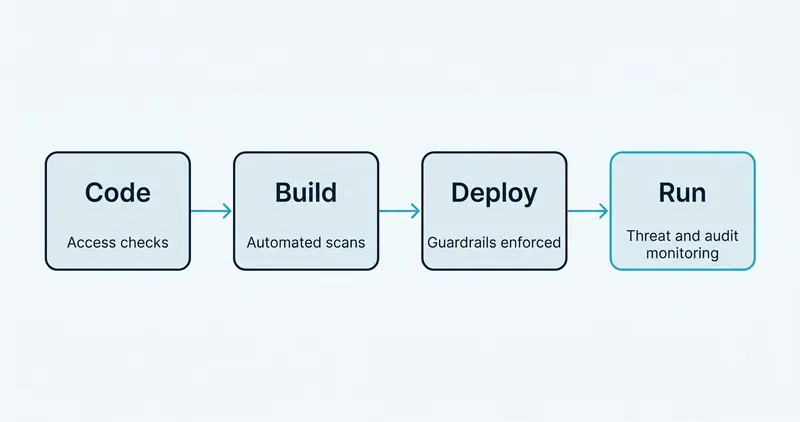
The pipeline runs the same way whether or not security is watching it. The difference is that each stage now carries its own check: access checks at the code stage, automated scans during the build, guardrails enforced at deploy and threat plus audit monitoring once the service is running.
This matters most the moment compliance turns from a someday task into an active blocker. If you’re heading toward SOC 2, HIPAA, ISO 27001 or GDPR, the work isn’t really about AWS itself. AWS’s own infrastructure is already certified. What you’re responsible for is the application layer: how you configure IAM, how you log activity and how tightly you scope access.
Framework | Setup time | Core AWS services |
|---|---|---|
SOC 2 | 2 to 4 weeks (single account) | IAM, CloudTrail, Config, GuardDuty |
HIPAA | 2 to 4 weeks | Encryption, access logging, BAA-eligible services |
ISO 27001 | 2 to 4 weeks | IAM, Security Hub, Control Tower |
GDPR | 2 to 4 weeks | Access controls, data residency, audit trails |
Multi-account setups | 4 to 6 weeks | Control Tower, Service Control Policies |
Perfsys handles this through our AWS security and compliance service, which sets up exactly that foundation: least-privilege IAM, GuardDuty and Security Hub for threat detection and Control Tower guardrails with the CloudTrail audit history auditors expect to see. Most engagements land in the $5,000 to $15,000 range depending on scope.
If your compliance automation tool, Vanta or Drata for example, keeps flagging failed checks, the tool usually isn't broken. The AWS controls underneath it are more likely the problem.
What Does DevOps as a Service Cost?
Pricing varies by provider and scope, but the honest answer is that DevOps as a service is usually cheaper than hiring the equivalent in-house team, especially for startups and SMBs that don’t need a full-time headcount for it year-round.
On AWS specifically, teams that bring in outside DevOps expertise typically see cloud costs drop by 20 to 40%, mostly from finding unused resources, right-sizing compute and automating scaling instead of running everything at peak capacity around the clock. AWS documents several of these cost optimization practices directly, and a good provider applies them continuously rather than as a one-time cleanup. Initial setup for CI/CD and infrastructure automation usually takes two to six weeks depending on how complex your existing environment is. That’s a fraction of the months a from-scratch internal build tends to take.
That’s the trade you’re actually making. You’re not paying for a cheaper version of DevOps. You’re paying to skip the hardest 20% of the work: hiring, retention and the mistakes a first-time in-house team makes while it’s still learning your stack.
How to Choose a DevOps as a Service Provider
Not every provider means the same thing when they say DevOps as a service. Before signing anything, ask these questions.
Who’s accountable when a release fails? A real partner owns the outcome and the fix. Red flag: an answer that’s vague or points back at your own team.
Do they stay past setup? Ask what support looks like in month six and month eighteen. Red flag: they can’t describe ongoing work in concrete terms.
Do you keep control of your AWS account? Look for providers who work through scoped, least-privilege IAM roles that you approve. Red flag: anyone asking for root access.
Can they show real, named outcomes? Ask for specifics: what changed, over what timeframe, with what numbers. Red flag: vague claims about improved efficiency with no details behind them.
Does the provider fit your cloud setup? A good partner adapts to your existing AWS architecture. Red flag: a full rebuild pitched around their preferred toolchain before they’ve reviewed yours.
DevOps as a Service Isn’t All or Nothing
You don’t have to choose between a full in-house team and handing over everything. Most teams that work with Perfsys keep their product engineers focused on features while we own the delivery pipeline, infrastructure and operations underneath. You can start with a cloud assessment to see exactly where the gaps are, then decide how much of the ongoing operation you want to hand off through tailored support packages.
That flexibility is the point. Startups usually start here because they can’t justify a full team yet. Growing companies stay because rebuilding a DevOps function from scratch every time they scale costs more than keeping the one that already works. If you want the deeper architecture and tooling side of this, we cover that separately in our guide to DevOps on AWS.
DevOps as a Service for Startups vs. Growing Companies
The math looks different depending on where your company is.
Early-stage startups usually can’t justify a full-time DevOps hire yet. You need one or two senior engineers’ worth of expertise, but only part of the time. A full salary for a fraction of the workload doesn’t pencil out, so the service model lets you pay for outcomes instead of headcount while your product team stays small and focused.
Growing companies hit a different wall. You might already have engineers touching infrastructure, but nobody owns it full time, so practices vary team to team. Standardizing CI/CD, IaC and monitoring across every squad internally takes months of internal alignment. A DevOps as a service provider that has already solved this for other companies your size gets you there faster, and keeps it consistent as you add teams.
Larger, regulated organizations tend to use DevOps as a service differently again. Less to fill a skills gap, more to enforce consistency across regions, products or business units without a full reorganization. The signals are less about headcount and more about audit readiness and change traceability holding up under scrutiny.
None of these are about company size alone. They’re about whether delivery, reliability and compliance are things your team can own well right now, or things you need running well starting this quarter.
FAQ
No. Consulting is project-based. A consultant builds or fixes your pipeline, then leaves. DevOps as a service means a provider keeps operating your infrastructure and pipelines long-term, similar to how an in-house team would.
No. A properly run DevOps as a service engagement uses least-privilege IAM roles that you approve. You keep full control of your AWS account at all times.
Most CI/CD and infrastructure automation setups take two to six weeks depending on how complex your current environment is. Ongoing operation continues well beyond that first release.
No. Startups adopt it because they can’t justify a full-time team yet. Larger, growing companies use it because standardizing delivery across teams and environments gets harder to do internally as headcount grows.
Yes. Providers that handle infrastructure automation typically also set up the access control, audit logging and monitoring that SOC2 and similar frameworks require, often as part of the same engagement.
It depends on your current setup, but teams commonly see cloud costs drop 20 to 40% once unused resources are identified and scaling is automated. That’s on top of avoiding the cost of hiring and retaining an in-house team.

We run the pipeline, the infrastructure and the monitoring so your engineers can stay on the product.


CEO & Founder @ Perfsys | Serverless architect with 10+ years of hands-on experience designing cloud-native architectures on AWS, backed by multiple AWS certifications. His writing bridges deep technical expertise with real-world business strategy, covering topics from AWS best practices to scaling tech-driven organizations.
AWS Experts, On-Demand
Need to move fast? Our cloud team is ready to scale, secure, and optimize your systems. Get serverless expertise, 24/7 support, and seamless CI/CD pipelines when you need it most.
Please accept cookies to load the booking widget.