

AWS Managed Services: What You Get and How to Choose
Published on Oct 9, 2026

You search for AWS managed services and find two different things sold under one name: a service run by AWS itself and a partner who runs your account for you. Add AWS Support and you have three options that sound identical. They cover very different ground. This guide shows what each one includes, how pricing works and what to check before you sign.
What are AWS managed services?
AWS managed services are ongoing operations for your AWS environment: monitoring, incident response, security and cost control, delivered by AWS itself or by a certified partner.
The phrase covers two different offers. AWS Managed Services is a service where AWS operates your accounts. A managed service provider (MSP) is a partner that works inside your environment. Fully managed features such as Amazon RDS add to the confusion. AWS patches the database engine for you, but nobody watches the rest of your account.
What does an AWS managed service provider do?
An AWS managed service provider, also called an AWS MSP, operates part of your AWS environment under a contract: it monitors your workloads and responds when something breaks.
The scope depends on the plan you sign. A light plan covers monitoring and troubleshooting. A heavier plan adds disaster recovery and round-the-clock incident response backed by an SLA.
A provider is a separate company that you contract with directly. You agree the scope, the hours and the response times with that company. The terms you sign are the service you get.
How do AWS Managed Services, an AWS partner and AWS Support compare?
AWS Support helps with AWS services. AWS Managed Services operates your accounts. A partner works inside your actual architecture.
Perfsys sits in the third row. We are an AWS Select Tier Partner with three AWS Service Delivery Designations, including AWS Lambda and Amazon DynamoDB. In 10+ years in AWS and DevOps we have delivered 70+ projects for 30+ international clients.
What does AWS Managed Services itself include?
AWS Managed Services runs day-to-day operations for your AWS accounts: monitoring, incident management and security, plus an optional patch add-on for EC2.
You choose which accounts AWS operates and which service levels apply. The full-lifecycle plan, called Advanced, adds landing zone management, infrastructure changes and access management. The AWS operations plans guide lists the details.
What changes with AWS Managed Services Advanced in 2027?
AWS will end support for the Advanced operations plan on June 30, 2027. After that date you can no longer reach its console or resources. AWS posts the notice in its Advanced user guide.
The current AWS FAQ lists only the Accelerate plan. If a comparison page still presents Advanced as an open choice, it is out of date. If you run Advanced today, ask whoever manages it for a migration plan now.
How is AWS managed services pricing structured?
AWS prices AWS Managed Services by the number of instances plus the usage fees of the other AWS services in the accounts it manages. You can check this in the AWS Managed Services FAQ.
Many third-party guides quote a flat percentage of your AWS bill instead. Treat those figures as one vendor's estimate and ask for a written quote for your own accounts.
Partner pricing is easier to read when it is published. Here is what CloudCare costs 👇🏻
What does Perfsys CloudCare include at each level?
Perfsys CloudCare is a set of three monthly AWS support plans, starting at $800 for 20 hours of senior engineer time.
Standard includes Well-Architected Reviews. For an example, read our Well-Architected review case study. Ultimate adds compliance audits, and you can see how we approach security and compliance on its own page. Monitoring runs through our observability and monitoring practice.
Every plan includes 5% off your AWS infrastructure costs through our authorized reseller partnership with TD SYNNEX. Your AWS account stays yours. We do not need root access, and you can change plans or cancel at any time. Compare all CloudCare plans.
You can buy CloudCare Basic and CloudCare Standard through AWS Marketplace, where each plan has its own listing. Ultimate is quoted on request.
How does a CloudCare engagement start?
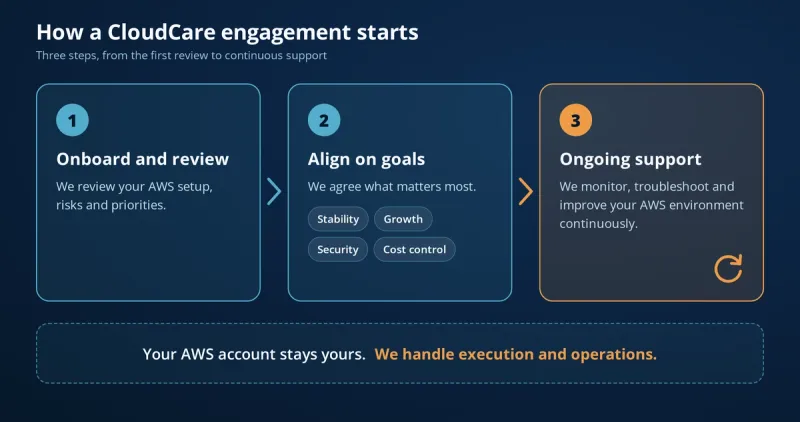
A CloudCare engagement starts with a review of your AWS setup, risks and priorities, then moves into agreed goals and continuous support.
- Onboard and review: we review your AWS setup, risks and priorities.
- Align on goals: we agree what matters most: stability, growth, security or cost control.
- Ongoing support: we monitor, troubleshoot and improve your AWS environment continuously.
You can start on Basic and move up a plan as your workload grows.
What does the AWS shared responsibility model mean for managed services?
AWS secures the cloud infrastructure and you secure everything you run in it, and a managed services provider takes on only the tasks your contract names.
AWS calls this the shared responsibility model: security of the cloud for AWS and security in the cloud for you. AWS protects the infrastructure that runs its services. Your side covers configuration, access control, data and applications, and the amount of work depends on the services you choose.
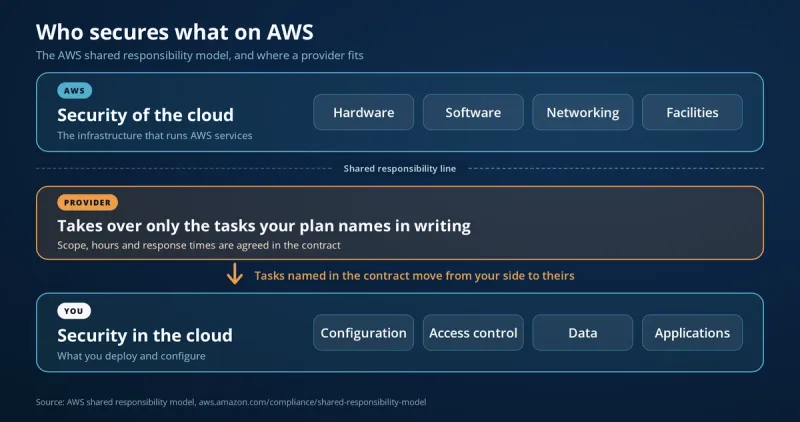
A provider does not move that line by itself. It takes over tasks from your side of it, and only the ones the plan names in writing. That makes the Scope and Access items in the checklist below the two to read twice. With CloudCare, permissions are agreed in advance and you keep ownership of your account.
What should you check before choosing a provider?
Check what the plan commits to in writing, because managed support only guarantees that someone is watching.
Our CEO Eugene Orlovsky puts it plainly:
"Managed support does not automatically mean optimized, secure or well-governed AWS. It means someone is watching and reacting. If you want proactive cost control, stronger security and good architecture, those must be explicitly included in your plan, with clear responsibilities and guardrails from day one."
— Eugene Orlovsky, CEO and Founder, Perfsys
Run this checklist before you sign 👇🏻
- Scope: which monitoring, cost reviews, security checks and architecture reviews each tier includes.
- Response times: the SLA by severity, and whether coverage runs 24/7.
- Hours: how many engineer hours you get each month and what happens when they run out.
- Access: who owns the AWS account and which permissions the provider needs.
- Exit terms: whether you can downgrade or cancel without a lock-in.
- Proof: the AWS partner tier and Service Delivery Designations, which you can verify in the AWS Partner directory.
💡 Pro tip: Ask each provider to mark which checklist items are included and which cost extra, then put that list in the contract.
When is CloudCare a better fit than AWS-run managed services?
CloudCare fits startups and SMBs that run production workloads on AWS without a dedicated cloud team and want published pricing with no lock-in.
Match the plan to the workload 👇🏻
- Basic: early-stage startups, MVPs and internal tools.
- Standard: growing SaaS products and production environments with steady traffic.
- Ultimate: business-critical systems, high-traffic platforms and regulated workloads.
AWS describes its own service for enterprises that want to offload infrastructure operations. Your first full-time cloud engineer is a bigger commitment than a plan you can cancel next month.
Conclusion
Managed support works when the scope is written down. Compare the three options on what each commits to in writing. Check the 2027 change before you pick an AWS-run plan. Then ask for a quote based on your own accounts.

Book a discovery call and we will map your environment to a CloudCare plan.

FAQ
They are ongoing operations for your AWS environment, delivered by AWS or by a certified partner. Scope varies by provider, so check what each plan commits to in writing.
AWS Support helps with AWS services themselves. A managed service operates your environment: it monitors, responds to incidents and improves the setup over time.
AWS bases pricing for its own service on instance counts and usage fees. Perfsys CloudCare publishes prices: $800 per month for Basic and $1,200 for Standard, with Ultimate on request.
Not with Perfsys. Permissions are agreed in advance and follow AWS security best practices. You keep full ownership of your account.
AWS describes it for enterprises that want to offload infrastructure operations. Startups and SMBs usually fit a partner plan with published pricing, such as CloudCare from $800 per month.
Yes. You can change plans or cancel at any time, with no lock-in.

Software Engineer at Perfsys with hands-on experience building scalable backend systems on AWS using Python and TypeScript. He works directly on cloud infrastructure projects, bringing practical engineering depth to every topic he covers.
AWS Experts, On-Demand
Need to move fast? Our cloud team is ready to scale, secure, and optimize your systems. Get serverless expertise, 24/7 support, and seamless CI/CD pipelines when you need it most.
Please accept cookies to load the booking widget.