
AWS Consulting
7 min read


30+
B2B customers served
~1 Billion
Relationships in graph
6 months
Migration timeline
Key Insights
Location
United States
Project duration
6 months
Industry
Fintech
Technologies used
Amazon Neptune, SPARQL, RDF, AWS Bedrock
Services
Solutions
Our client was a US-based mortgage technology startup backed by a top-tier venture capital firm. Its goal was straightforward: build the API infrastructure layer that the US mortgage industry had never had. Getting a mortgage at the time took an average of 45 days and cost lenders over $9,000 per loan. The platform aimed to bring that down to 10 days and $1,000 by connecting every party in the origination process, loan servicers, brokers, banks, and credit bureaus, onto one platform where data could move without manual translation.
The execution was hard. Every customer connecting to the platform brought its own data sources, and every data source spoke its own language. A bank's data about a borrower's credit history looked nothing like a title company's data about a property, and neither looked anything like what a broker tracked about a transaction. The client needed a way to absorb all of it into a single, queryable layer without forcing every new customer through months of schema mapping first.
That requirement, handling structurally unpredictable data from five different industries inside one system, is what eventually led the client to Amazon Neptune graph database as the foundation of its data architecture.
Loan origination looks simple from a distance: a buyer, a seller, a property, a bank account, a credit rating. In practice, the entities involved and the relationships between them are far less predictable. A property might sit in a flood zone, which changes its risk profile. A buyer's co-signer might have an unrelated legal issue that affects the deal. These aren't edge cases that show up occasionally. They're the normal texture of real loan files, and there's no way to enumerate them all in advance.
That unpredictability is what ruled out the obvious database choices. A relational database requires the schema to be defined before the data arrives, which doesn't work when you don't know in advance what entities or relationships a given customer's data will contain. A document-oriented, non-relational option such as Amazon DynamoDB handles flexible storage well but isn't built for querying relationships between documents, and relationships were the entire point.
What the platform needed was a system designed around connections rather than fixed tables. That pointed toward a graph database.
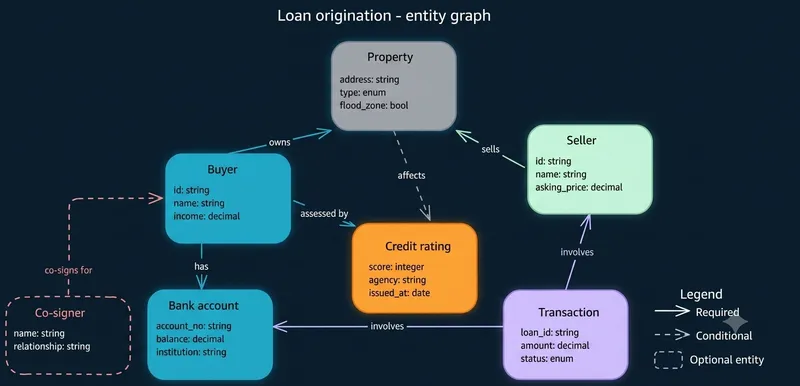
The core business challenge was building a single platform that could ingest loan-related data from many different sources, each with its own data language, and make that data queryable in a unified way, without locking the system into assumptions about what the data would look like.
This created several compounding constraints:
Graph databases carry a reputation in the industry for being harder to reason about than relational or document databases, mostly because fewer engineers have worked with one day to day. For a business problem defined by unpredictable relationships across multiple domains, that reputation didn't hold up in practice.
Perfsys evaluated the data problem against the constraints above and arrived at a decision-driven rather than feature-driven approach. The choice of engine mattered more than any individual feature.
The architectural decision: Use Amazon Neptune graph database as the system of record for loan origination data, modeled with RDF (Resource Description Framework) and queried via SPARQL rather than Neptune's Gremlin property-graph option.
Why RDF and SPARQL specifically: The existing lexicon for the loan domain, the vocabulary the client needed to express entities and relationships in, already existed in RDF form. Building on that lexicon meant the data model could express subject-predicate-object statements ("buyer has bank account," "seller owns property") in a way that mapped directly onto how the business already talked about loan data.
Why a graph database over the alternatives:
Why Amazon Neptune specifically: As a fully managed AWS service, Neptune removed the operational burden of running graph infrastructure at scale, which mattered given the eventual size of the dataset. It also supports both major graph query paradigms (Gremlin and SPARQL), giving the client flexibility to align with its existing RDF-based vocabulary rather than rebuilding it from scratch.
A secondary design principle shaped the approach as much as the choice of engine: building for a future where the same data could feed AI systems as well as human-facing dashboards and APIs. Subject-predicate-object structures map naturally onto how large language models process language. A Neptune-based graph solved today's query problem and set up the data to work well with retrieval-augmented generation (RAG) and AWS Bedrock knowledge bases later, without a second migration.
Perfsys led the migration of the client's data layer from its prior storage approach onto Amazon Neptune graph database, completed over roughly six months. The migration wasn't a lift-and-shift. Entities and relationships had to be remodeled as RDF triples rather than rows or documents, with the existing domain lexicon used as the foundation for the new schema-less structure. By the end of the project, every data point the platform touched lived in Neptune.
Rather than defining a rigid set of tables, Perfsys modeled the loan origination domain as a network of entities, buyers, sellers, properties, bank accounts, credit ratings, financial transactions, connected by relationships expressed in SPARQL. This meant new relationship types (a flood zone designation, a co-signer's credit issue) could be added as they appeared in real customer data, without requiring a schema migration or downtime. The graph grew to encompass 200 million+ data points and close to a billion individual connections.
Because the underlying data model captured relationships rather than rigid per-customer schemas, the same graph could answer fundamentally different questions for different types of customers. Loan servicing companies queried it for data tied to active loans. Brokers queried it for property and buyer information. Banks and credit bureaus queried it for financial and credit-related aspects of the same underlying records. The client onboarded more than 30 B2B customers across five distinct industry segments onto this single data layer, each able to query the graph from its own angle without requiring a separate data model per customer.
While the original project predates the current generation of graph-based retrieval-augmented generation tooling, the architecture Perfsys built anticipated it. Graph databases structured around subject-predicate-object relationships are a natural fit for AWS Bedrock knowledge bases, because large language models reason more effectively over explicit entity relationships than over flat documents or relational joins. The RDF-based Neptune model gave the client's data a structure that could plug into AI agents and Bedrock-based retrieval without re-architecting the underlying graph.
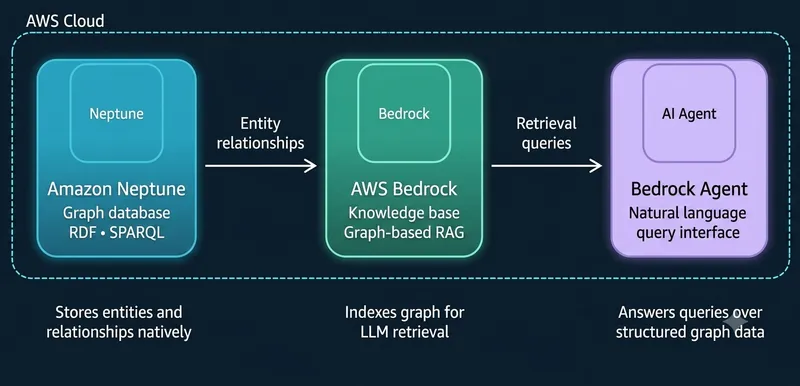

If your platform aggregates data from sources that don't share a common schema, Perfsys helps assess whether a graph database approach, and a path toward AWS Bedrock-based AI agents, fits your architecture. Contact us to talk through your data model.
Amazon Neptune is a fully managed AWS service, which shifted patching, backups, and infrastructure-level reliability concerns away from the client's engineering team. That said, keeping a graph database of this scale healthy in production required deliberate monitoring: query performance, cluster availability, and write throughput all needed active attention as the dataset grew into hundreds of terabytes. Running Neptune inside a VPC with restricted network access and applying AWS Identity and Access Management (IAM) least-privilege roles for any service touching the graph kept the platform aligned with the access-control expectations of bank and credit bureau customers, entities with their own regulatory obligations around the data they were querying.
The graph database approach let the client support a fundamentally heterogeneous customer base, five industries with different data needs, without maintaining five different data models. New customers and new data relationships could be absorbed into the existing graph rather than triggering a schema change, which is what made it possible to scale to 30+ B2B integrations on a single platform. The RDF-based structure also meant the data was already shaped in a way compatible with later AI-driven retrieval, avoiding a second re-architecture when graph-based RAG became viable on AWS.
This project demonstrates that graph databases are not a niche choice for businesses dealing with genuinely unpredictable, relationship-heavy data. They're often the only architecture that scales without constant schema rework. For teams in a similar position, the natural next steps building on this kind of foundation include:
Relational databases require a fixed schema decided in advance, which breaks down when every new data source or customer introduces entities and relationships that weren't anticipated. Amazon Neptune graph database stores entities and relationships natively, so new relationship types can be added without a migration. For platforms aggregating data from many unpredictable sources, that flexibility is usually the deciding factor.
The pattern matters more than the scale. Any platform pulling data from multiple sources that don't share a common structure, even a handful of integrations, runs into the same schema-rigidity problem a relational database creates. Smaller teams can start with a much smaller Neptune graph and let it grow with their customer base, rather than waiting until the dataset is large to justify the switch.
Amazon Neptune supports both. RDF and SPARQL fit well when there's an existing vocabulary or ontology to build on, as there was in this case. Gremlin's property-graph model often fits better for teams without a pre-existing RDF lexicon who want a more code-like query style. The right choice depends on the data model already in use, not a general rule.
Graph databases structure data as subject-predicate-object relationships, which closely mirrors how natural language expresses facts. That structural similarity makes it easier for large language models to reason over graph data than over relational joins or flat documents, which is part of why Amazon Bedrock knowledge bases support Neptune-backed retrieval for RAG applications.
Cost depends primarily on the size and complexity of the existing data model and how much remodeling is required to convert it into entities and relationships. A six-month migration timeline, as in this case, reflects a large-scale, multi-industry dataset. Smaller or more structurally consistent datasets typically migrate faster and at lower cost.
Yes. The underlying problem, unpredictable entities and relationships across many data sources, shows up in healthcare data exchange, supply chain and logistics tracking, fraud and risk graphs in financial services, and any B2B platform aggregating data on behalf of multiple downstream customers. The graph database pattern applies wherever relationships, not rigid records, are the core of the data.
Yes. Beyond the initial migration, Perfsys offers managed support for AWS-based data infrastructure, including monitoring graph database performance and availability, managing IAM access controls, and extending the data model as new customers or data sources are added.
It's possible with a phased approach: running the graph database alongside the existing system, migrating data domain by domain, and cutting over reads and writes incrementally. The right migration path depends on how tightly the existing application logic is coupled to the current database structure.
We help startups and SMBs handling complex, multi-source data move to graph database architectures on AWS, and connect that data to AI agents when the time is right.

CEO & Founder @ Perfsys | Serverless architect with 10+ years of hands-on experience designing cloud-native architectures on AWS, backed by multiple AWS certifications. His writing bridges deep technical expertise with real-world business strategy, covering topics from AWS best practices to scaling tech-driven organizations.
Recommended for You
AWS Experts, On-Demand
Need to move fast? Our cloud team is ready to scale, secure, and optimize your systems. Get serverless expertise, 24/7 support, and seamless CI/CD pipelines when you need it most.
Please accept cookies to load the booking widget.