
AWS Consulting
7 min read


~10x
faster incident response
100K+
Lambda invocations tracked per month
30
customer deployments under unified observability
Key Insights
Location
North America / Europe
Project duration
3 weeks
Industry
SaaS
Technologies used
AWS Lambda, DynamoDB, Athena, S3, IAM, Lumigo, CloudWatch, AWS SAM
Nogalis is a software company in the ERP archiving space. Their product allows enterprise customers to retire expensive ERP systems by migrating historical data into a read-only archive hosted on AWS. Instead of maintaining costly licenses for legacy ERPs, Nogalis customers pay for a simpler, cheaper alternative that preserves full access to their archived records.
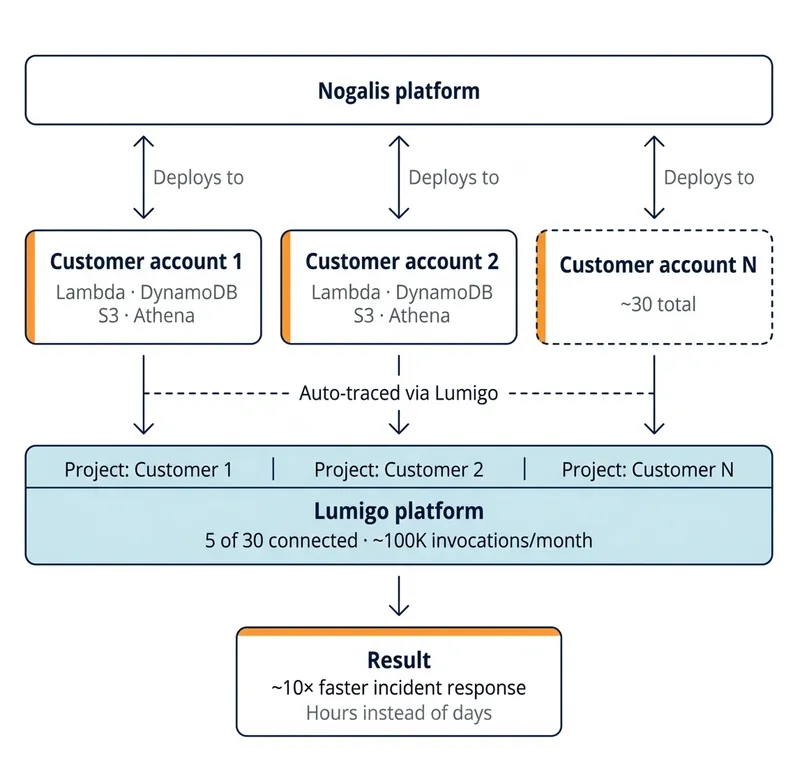
What makes Nogalis architecturally unusual is their single-tenant SaaS model. Every customer gets a dedicated deployment in its own AWS account. With approximately 30 customers, that means 30 separate environments, each running its own set of AWS Lambda functions, DynamoDB tables, Athena queries, and S3 data lakes.
This model provides strong isolation and data security, but it comes with a cost: without centralized observability, the Nogalis team had almost no way to know what was happening across those 30 environments. When something broke, they found out late. When a customer experienced degraded performance, debugging took days. Nogalis came to Perfsys to fix that.
Nogalis faced a set of questions that every SaaS business owner eventually encounters: Is production running correctly? Are customers experiencing failures? If so, where? And when a problem surfaces, how quickly can the team identify and resolve it?
The challenge was amplified by the single-tenant deployment model. With each customer isolated in its own AWS account, there was no single pane of glass to monitor health, usage, or errors. The team had some basic CloudWatch alarms in individual accounts, but those were neither centralized nor actionable.
The specific problems included:
We had no good information about what was going on with all those customers. We had no idea whether the system was running properly, how it was being used, or where failures were happening. — Eugene, Perfsys Engineering Lead, describing the client's situation
Perfsys structured the engagement in two phases: first, evaluate and select the right observability platform; second, integrate it across Nogalis's deployment pipeline. The total timeline was approximately three weeks.
Perfsys evaluated two platforms: Lumigo and Dash0. The selection criteria were driven by Nogalis's specific constraints: a serverless-first architecture on AWS, a small team with limited time for tooling overhead, and a need for per-customer visibility mapped to individual AWS accounts.
Criterion | Lumigo | Dash0 |
|---|---|---|
Serverless support | Native AWS Lambda tracing; purpose-built for serverless | Broad support; stronger for containers (ECS, Kubernetes) |
Per-customer view | Project-based mapping to AWS accounts; natural fit for single-tenant | Supported, but less intuitive mapping |
Cross-account dashboard | Not supported at the time of evaluation | Better multi-account aggregation capabilities |
Ease of use | Simple interface, minimal learning curve | More powerful but steeper learning curve |
Trace visualization | Strong trace map for Lambda invocation chains | Comparable trace capabilities |
Team fit (5-person team) | Low operational overhead; quick onboarding | Requires more configuration and expertise |
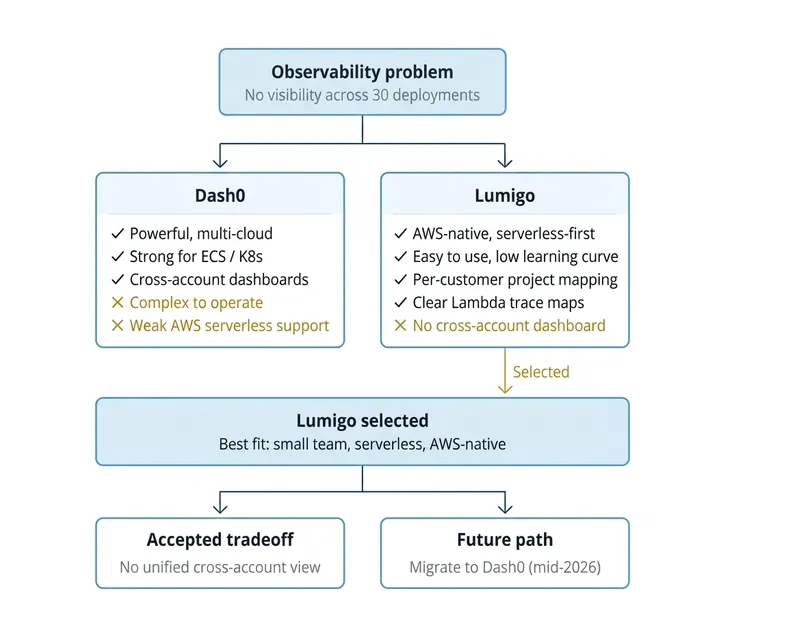
Lumigo won the selection based on two decisive factors: its trace map for serverless invocation chains and its ease of use for a small team. Nogalis had already tried Datadog and found it too complex. Dash0, while more capable in multi-cloud and container scenarios, presented a similar risk of underutilization.
Perfsys identified one clear tradeoff: Lumigo could not provide a single unified dashboard across all 30 customer accounts. This was validated through an MVP test during the evaluation phase. Both Perfsys and Nogalis agreed to accept this limitation in exchange for faster adoption and higher day-to-day usability.
With Lumigo selected, Perfsys moved into integration. The goal was to embed observability directly into Nogalis's existing deployment pipeline so that every new customer environment would be monitored automatically, without manual setup.
Perfsys conducted an independent evaluation of Lumigo and Dash0, producing a detailed comparison document with pros, cons, and a clear recommendation. The evaluation focused on how each platform handled serverless-specific telemetry, per-account project mapping, and the operational burden on a five-person team. The evaluation included a proof-of-concept to test whether Lumigo could support a cross-account aggregated view. When this proved infeasible, Perfsys documented the limitation and presented it to Nogalis as a conscious tradeoff, not a hidden gap.
Each Nogalis customer maps to a dedicated AWS account. Perfsys configured a one-to-one mapping between customer accounts and Lumigo projects. This gave the Nogalis team a per-customer view where they could inspect invocation patterns, trace failures, and review performance for any individual customer without cross-contamination from other accounts. The mapping was designed to be automatic — whenever Nogalis deployed a new customer environment, the corresponding Lumigo project was created and configured as part of the deployment process, requiring no manual steps.
Nogalis's platform is heavily serverless, relying on AWS Lambda for most application logic. Perfsys enabled Lumigo's auto-tracing and auto-discovery features so that every Lambda function deployed within a customer account was automatically instrumented. This captured invocation counts, durations, error rates, and full execution traces without requiring code changes in the application layer. Critically, the configuration included logic to separate warmup invocations from real user-triggered calls — essential for accurate usage reporting and for identifying genuine issues without noise from synthetic keep-alive traffic.
For Lumigo to pull resource data and traces from each customer's AWS account, it needs appropriately scoped access. Perfsys created a dedicated IAM role for Lumigo in each customer account, following the principle of least privilege. The role grants Lumigo read access to the resources it needs to monitor, while preventing any write operations or access to customer data. This IAM configuration was integrated into the Infrastructure as Code templates used during customer deployments, ensuring access controls are consistent, auditable, and impossible to skip.
The most important architectural decision was making observability a built-in part of the deployment process rather than a bolt-on. Perfsys modified Nogalis's CI/CD pipeline so that deploying a new customer account automatically provisions the Lumigo project, assigns the IAM role, and enables auto-tracing for all Lambda functions. The deployment templates were built using AWS SAM, ensuring consistent and repeatable infrastructure across all customer environments. For an organization with five people managing 30 customer environments, this kind of automation is not a convenience — it is a requirement for operational sustainability.
Given that Nogalis manages archived enterprise data on behalf of its customers, security was a non-negotiable constraint throughout the implementation. Least-privilege IAM roles ensure Lumigo has only the minimum access needed to collect traces and metrics from each AWS account. Customer account isolation is preserved throughout the observability setup — each Lumigo project maps to exactly one AWS account, with no cross-account data leakage. All IAM role configurations are version-controlled and deployed through Infrastructure as Code, providing full audit trails. The integration was designed to align with the SOC 2 compliance posture Nogalis was already pursuing across its AWS Organization, managed through AWS Control Tower.
Before this engagement, Nogalis operated 30 customer deployments with minimal insight into system health, usage patterns, or failure rates. After three weeks of work with Perfsys, the team has per-customer observability, automated tracing across all Lambda functions, and the ability to identify and respond to incidents roughly 10 times faster than before. For a five-person company managing enterprise-grade data archiving, this is the difference between reactive firefighting and proactive operations.
Approximately 100,000 Lambda invocations are now tracked per month — providing real-time visibility into how customers use the platform, where errors occur, and which deployments need attention. All 30 customer deployments are covered: 5 large accounts were fully connected at launch, with the remaining environments instrumented for automated onboarding. Zero manual setup is required for new customers: observability is embedded in the deployment pipeline, eliminating configuration drift and human error. The failed Datadog implementation was replaced with a platform the team actually uses daily.

We help SaaS companies and startups design and implement serverless observability solutions that fit their architecture, team size, and budget. Whether you run single-tenant deployments, multi-account setups, or serverless workloads on AWS, Perfsys can help you move from guessing to knowing.
In three weeks, Perfsys took Nogalis from fragmented CloudWatch alarms to a fully automated, per-customer observability platform integrated into their deployment pipeline. The Nogalis team now has the visibility to make informed operational and business decisions across all 30 customer environments.
Planned next steps include migrating from Lumigo to Dash0 when the product consolidation is complete (expected mid-2026), extending observability coverage with custom business metrics and usage-based dashboards, implementing cross-account aggregated alerting, and continuing SOC 2 compliance alignment with observability data supporting audit and incident response documentation.
Lumigo was selected because of its native support for AWS Lambda tracing, its project-based architecture that maps cleanly to single-tenant AWS accounts, and its low learning curve. For a five-person team that had already struggled with Datadog's complexity, ease of adoption was a decisive factor. Dash0 offered stronger multi-cloud and container support but was better suited for larger teams with dedicated DevOps resources.
Yes. The principles Perfsys applied — automated instrumentation, per-environment project mapping, and pipeline-integrated monitoring — are applicable to multi-tenant SaaS, microservices architectures, and multi-account AWS setups. Perfsys has applied similar approaches in its AWS migration and CI/CD work for other clients.
This engagement was completed in three weeks for a five-person company. Perfsys scoped the work to fit a small team's budget and operational capacity. Lumigo's pricing model, based on traced invocations rather than per-seat licensing, also keeps ongoing costs manageable for smaller organizations. Perfsys regularly works with startups and SMBs at similar scale.
The Lumigo product remains operational, and all work Perfsys delivered continues to function. The functionality Lumigo provides is being incorporated into Dash0. Perfsys has recommended that Nogalis plan a migration to Dash0 when the product consolidation is complete, expected by mid-2026. All observability principles and pipeline integrations will carry over.
Yes. Perfsys offers managed services subscriptions that include monitoring, incident response, and continued optimization. For this engagement, the work was delivered under a subscription model where tasks were prioritized based on Nogalis's evolving needs. Perfsys can also support the future migration from Lumigo to Dash0 as part of an ongoing engagement.
Serverless environments introduce challenges that traditional monitoring tools are not designed for — ephemeral compute instances, cold start variability, and high invocation volumes with short execution times. Serverless observability platforms like Lumigo are built to trace individual invocations across distributed function chains, providing the granularity needed to debug issues in event-driven architectures. Perfsys has deep experience with serverless performance optimization on AWS.
Absolutely. Any company running serverless workloads on AWS — particularly those with multi-account or single-tenant deployment models — can apply the same methodology. Perfsys has implemented similar observability and telemetry configurations for clients in fintech, digital health, and SaaS across Europe and North America. See all Perfsys case studies for examples.

CEO & Founder @ Perfsys | Serverless architect with 10+ years of hands-on experience designing cloud-native architectures on AWS, backed by multiple AWS certifications. His writing bridges deep technical expertise with real-world business strategy, covering topics from AWS best practices to scaling tech-driven organizations.
Recommended for You
AWS Experts, On-Demand
Need to move fast? Our cloud team is ready to scale, secure, and optimize your systems. Get serverless expertise, 24/7 support, and seamless CI/CD pipelines when you need it most.
Please accept cookies to load the booking widget.