
Migration
15 min read


5 days
to a live environment
6 weeks
to controlled launch
0
failed releases
Key Insights
Location
United Kingdom
Project duration
6 weeks to public launch, then ongoing
Industry
Fintech
Technologies used
ECS Fargate, RDS PostgreSQL, ElastiCache Valkey, S3, CloudFront, WAF, Secrets Manager, SES, Terraform, GitHub Actions
A fintech platform that stores government IDs and moves money across borders cannot launch from a developer laptop. OlivPay had a working prototype and needed it hardened for real production.
Building AWS infrastructure for a fintech startup in that position means fixing security, delivery and reliability together. Perfsys took OlivPay from an empty AWS account to a live environment in 5 days, and to a controlled launch in 6 weeks.
One example is the order emails. They went out through a provider that rejected every message, and the code logged each rejection as a success, so senders received no confirmations. It was a basic bug, and we fixed it before launch.
OlivPay runs a pay-for-me platform. Senders in the UK, US and EU buy goods and services directly for recipients in Nigeria, Ghana and Liberia, instead of sending cash. Handling payments and identity documents means a data leak or a pricing error would hit a young company hard.
OlivPay arrived with a prototype that worked. For real production, four areas needed hardening:
Behind these sat a quieter risk. Several integrations defaulted to test endpoints, so a production release could have quietly pointed at sandbox systems.
We audited the plan before touching the account. We checked the client's 12-deliverable plan against the real code and adjusted it. Three deliverables needed rework and two were larger than planned. The storage migration touched about 34 places, well beyond the 8 planned. The scope was fixed before any infrastructure spend.
We prepared the app while the account was being set up. Eleven workstreams ran in parallel, so preparation cost no calendar time.
The client approved every live change. Every production change was reviewed first, and the reviewed change was the one applied.
Staging mirrors production. Both run the same Terraform code, so what passes in staging behaves the same live. The platform runs in AWS London, close to UK senders.
We added a production build, a health check and structured logging. Critical vulnerabilities in dependencies dropped from 5 to 0, and in the container image from 3 to 0.
Everything moved to encrypted S3 storage with public access blocked. Documents are opened only through time-limited links.
A shared Amazon ElastiCache layer now handles rate limiting, live merchant notifications and scheduled jobs. Scaling out is now a setting change.
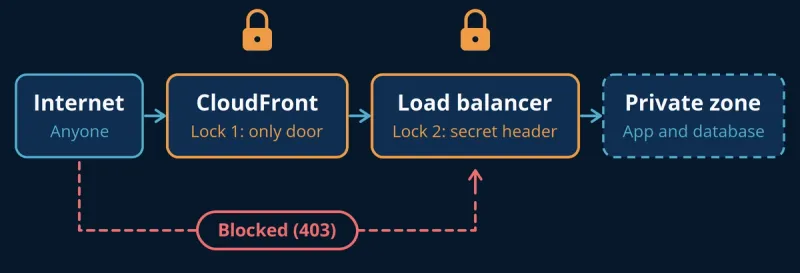
The runtime is Amazon ECS Fargate behind CloudFront, with a private, encrypted Amazon RDS PostgreSQL database that has no route to the internet. Production's first build was 91 resources in a single reviewed Terraform apply, with nothing changed or destroyed.
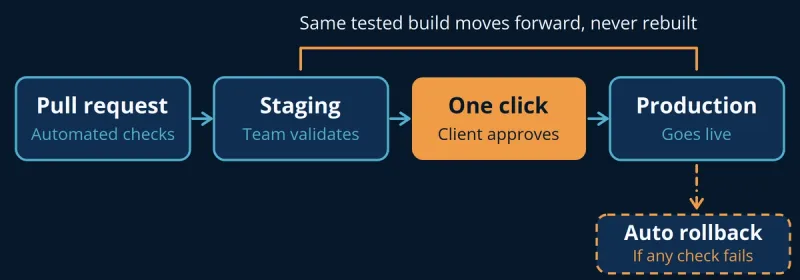
A change goes through automated checks, then to staging, then to production after one approval. Production reuses the exact image tested in staging, and any failure rolls back automatically. The pipeline holds no long-lived cloud credentials.
Each environment has 10 CloudWatch alarms and a dashboard. One of them fires when zero healthy instances are running, since a platform that is fully down generates no traffic to trigger other alerts. We built the same kind of visibility for another client: see the serverless observability case study.
Two more issues we fixed before launch. The app's database password rotated every 7 days while the stored copy went stale, and the first container image carried inherited vulnerabilities that stopped the release gate until we rebuilt it on a minimal base.
The platform holds identity documents, business registration certificates and payment data, so every design choice was made against that risk. For ongoing coverage after launch, see our security and compliance services.
What impressed me most was Perfsys' personal approach. As a startup, we needed a knowledgeable team that was accessible and responsive, and Perfsys struck that balance perfectly, with direct access to the people doing the work. They delivered a production-ready OlivPay on schedule and within budget, and as a non-technical founder I especially appreciated their guidance.
Shola Tinubu
Founder at OlivPay
OlivPay's founder, who describes himself as non-technical, rated the engagement 5.0 on Clutch. He highlighted direct access to the engineers, quick decisions and clear communication. Read the full review on Clutch.
Perfsys turned a working prototype into a live fintech platform on AWS, with the client's team shipping through it from the first week. Another fintech project: how we fixed an AI assistant that ignored its knowledge base.
The documented roadmap covers:

We design and build production-ready AWS environments for startups and SMBs, from release pipelines to monitoring.
A deployable build, private encrypted data stores, a controlled public entry point, secrets management, a tested release and rollback path, plus alerting that reaches someone. Here, all of it was built as Terraform code.
Staging was live in 5 days, the first production deployment came on day 26 and the controlled launch on day 41.
Yes. The launch used a lean footprint with named triggers for scaling up, which keeps costs in check without cutting corners on safety.
The platform reverts to the previous healthy version automatically, and the pipeline reports the failure instead of hiding it.
Yes, through managed support packages for ongoing monitoring and incident response.

Software Engineer at Perfsys with hands-on experience building scalable backend systems on AWS using Python and TypeScript. He works directly on cloud infrastructure projects, bringing practical engineering depth to every topic he covers.
Recommended for You
AWS Experts, On-Demand
Need to move fast? Our cloud team is ready to scale, secure, and optimize your systems. Get serverless expertise, 24/7 support, and seamless CI/CD pipelines when you need it most.
Please accept cookies to load the booking widget.